Lesson Steps
    Add a header to begin generating the table of contents

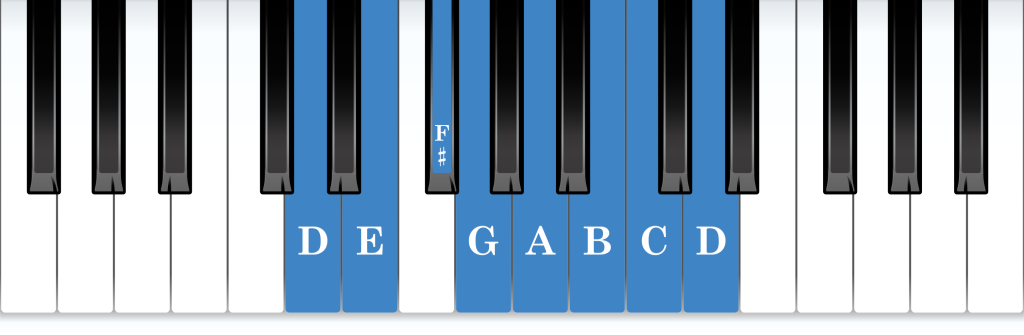
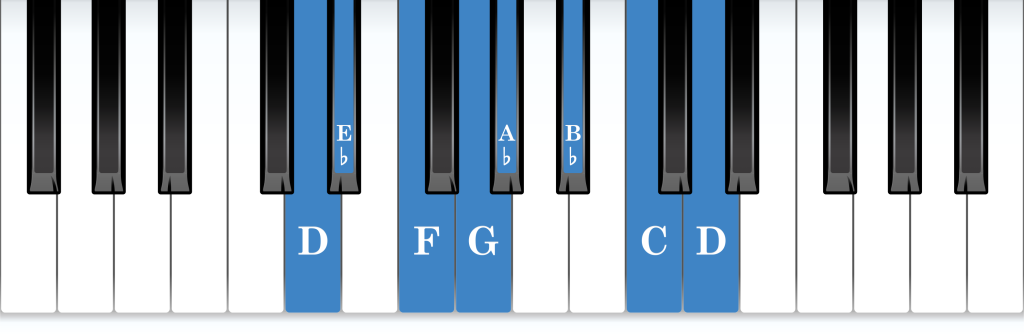
    D Aeolian Mode

    The D Aeolian mode is the D natural minor scale under its modal name: D, E, F, G, A, B-flat, and C. Let’s look at it on the keyboard and on the staff, with fingering for both hands, and hear where it sits among the seven modes.

    Lesson Steps
      Add a header to begin generating the table of contents

      D Aeolian mode overview

      Visualize the D Aeolian mode on the piano

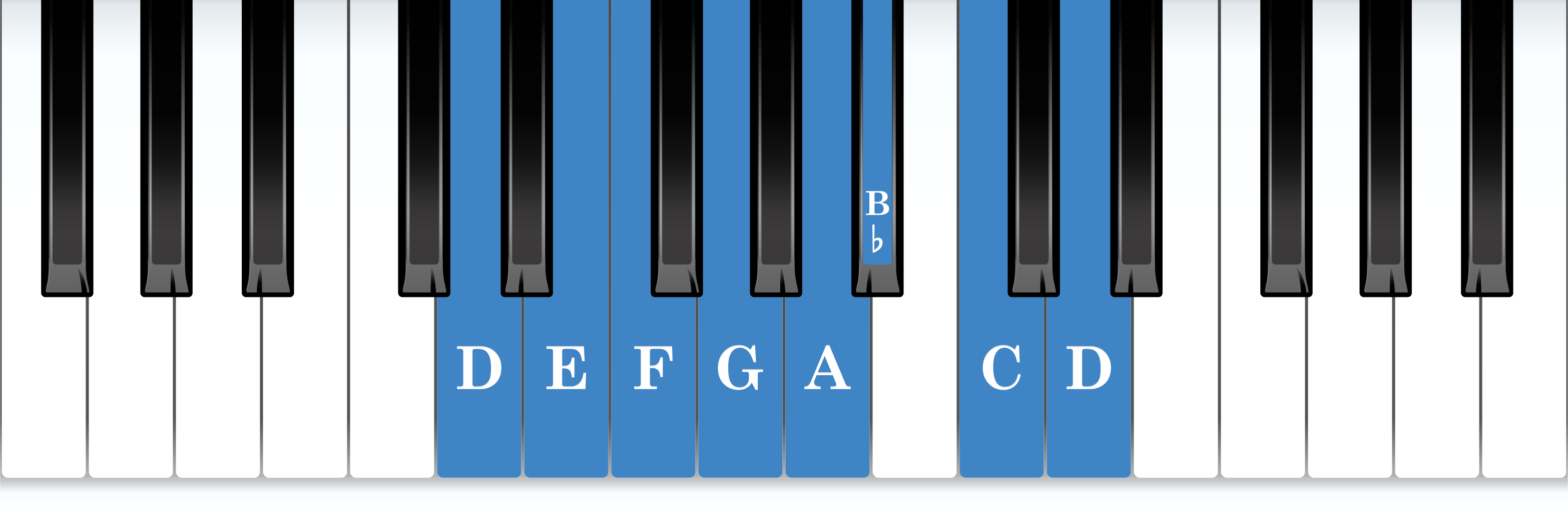
      On the keyboard, D Aeolian uses D, E, F, G, A, B-flat, and C, with B-flat on black key, and D again at the top. These seven notes are the F major scale, started on its 6th note. The notes are shared, but the home note is D, and that changes how the scale sounds.
      What gives D Aeolian its sound

      The D Aeolian mode and the D natural minor scale are the same scale: the same notes, the same fingering, and the same sound. Aeolian is the name the natural minor takes when we place it among the modes.

      It’s a useful reference point. Dorian, Phrygian and Locrian can each be heard as this scale with a note or two changed.

      Play D Aeolian on the piano

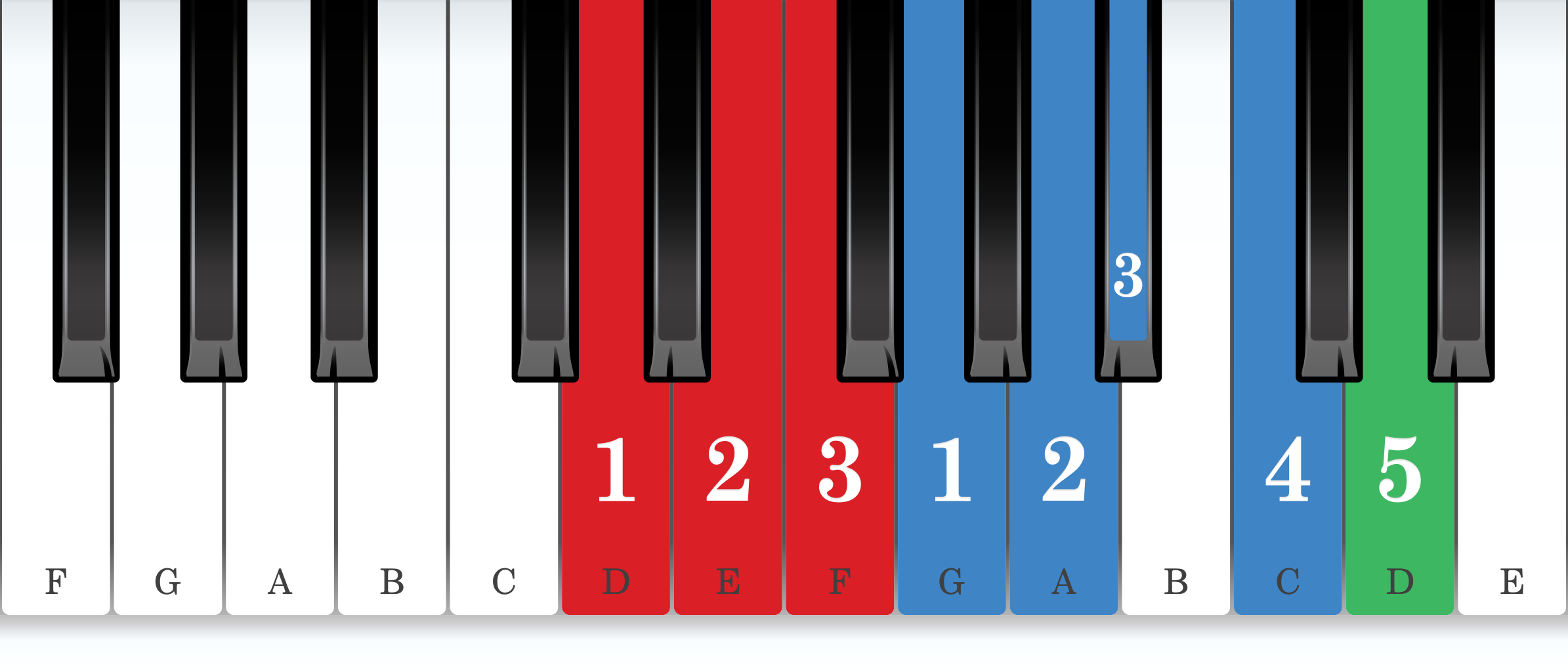
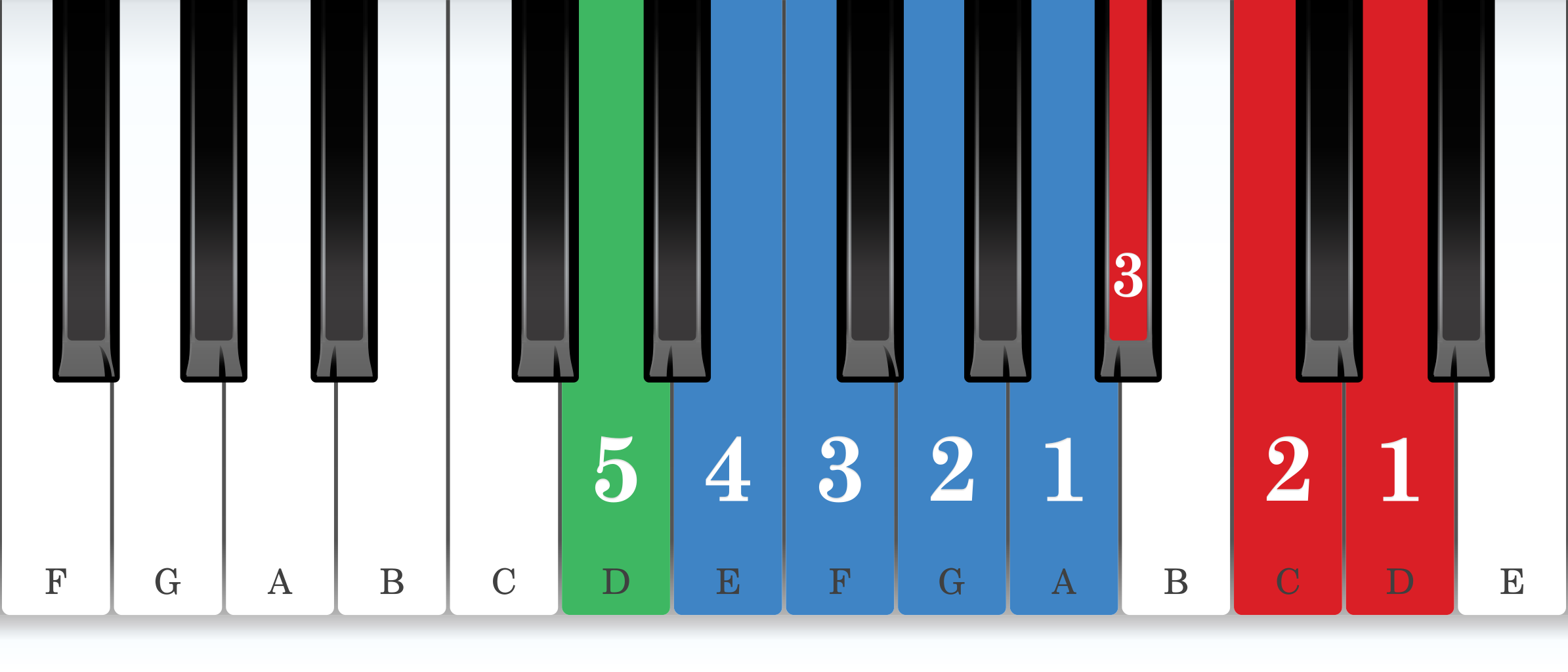
      The two charts show the fingering one hand at a time. Each hand covers the seven notes in two positions, a group of three fingers (red) and a group of four (blue); a note in green is an extra note at the end of the scale, outside the two positions.

      The right hand starts on D with the thumb. Going up, the thumb passes under to G after the 3rd finger on F. The top D is played with the 5th finger. This is the fingering of the D natural minor scale.

      The left hand starts on D with the 5th finger. Going up, the 3rd finger folds over the thumb from A to B-flat. The top D is played with the thumb. This is the fingering of the D natural minor scale.
      The notes of D Aeolian on the staff

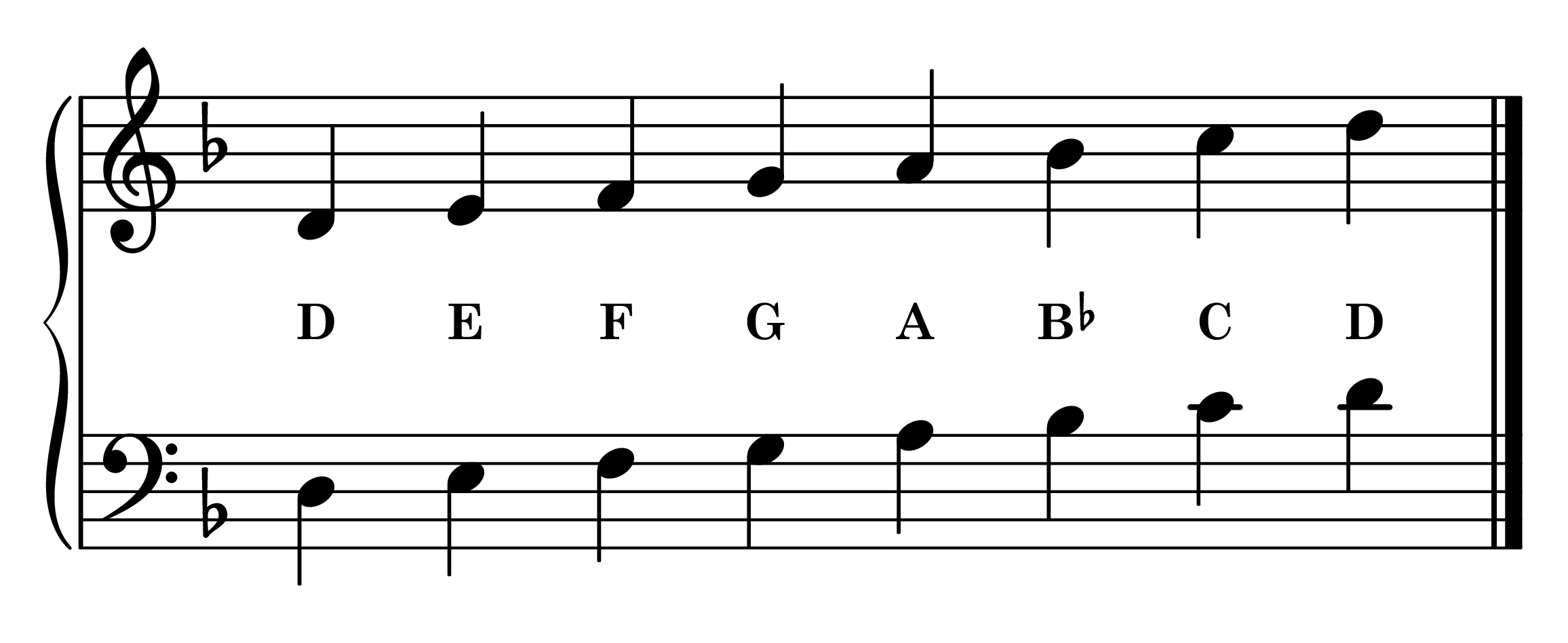
      On the staff, the eight notes climb by step from D to D, the right hand in the treble clef and the left hand an octave lower in the bass clef. D Aeolian is written with the key signature of F major: one flat, B-flat. The key signature belongs to F major, but here the line begins and ends on D, and that’s what makes it D Aeolian.
      Play D Aeolian up and down one octave

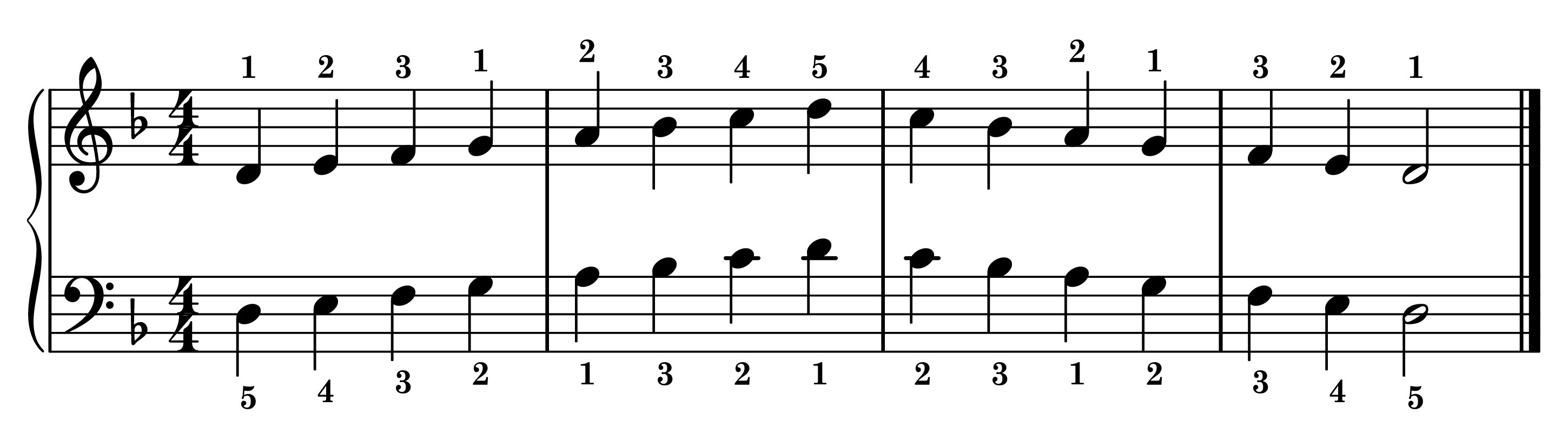
      Next, D Aeolian as we’ll practice it: up one octave and back down, one note per beat, ending on a half note. The fingering for the right hand is written above the notes and for the left hand below.
      Practice D Aeolian

      The notes and fingering are those of the natural minor scale, so the hands usually know them already. What’s worth practicing is evenness and a clear sense of the minor home note. Let’s work on it in a few stages.

      • Find the home note first: Before the scale, we play the D minor chord and let it ring, then play the scale and end on the same chord. The aim is to keep D as the center the whole way through.
      • Compare with a neighbor: We play D Aeolian and then D Dorian, listening for the one note that changes. It shows how little it takes to move from one mode to the next.
      • Hands separately, then together: Each hand alone first, slowly and evenly, with special attention to the thumb passing under to G in the right hand. Then hands together, an octave apart, keeping the pulse even.
      • Shape the line: Once it’s steady, we let the scale grow a little toward the top and relax on the way down. It turns the scale into a phrase and keeps the ear involved.

      Avoid common mistakes in D Aeolian

      A few things tend to go wrong in D Aeolian:

      • Hearing F as home: Because the notes are those of F major, the ear tends to treat F as the center and D as a passing note. Starting and ending firmly on D, and playing the D minor chord around the scale, keeps the mode’s own center clear.
      • Uneven thumb notes: The thumb plays on its side and tends to land heavily, especially right after passing under. Letting the thumb travel early and arrive lightly keeps the line even.

      Other techniques related to D Aeolian:

      Other modes on D

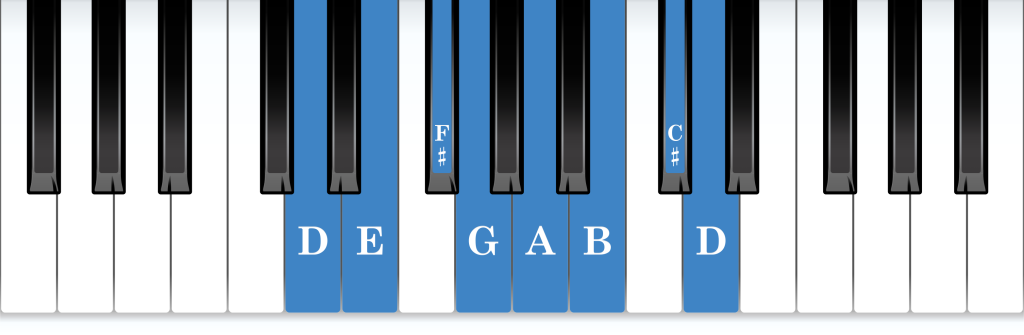
      D Ionian

      D Ionian mode piano notes diagram
      D E F♯ G A B C♯ D

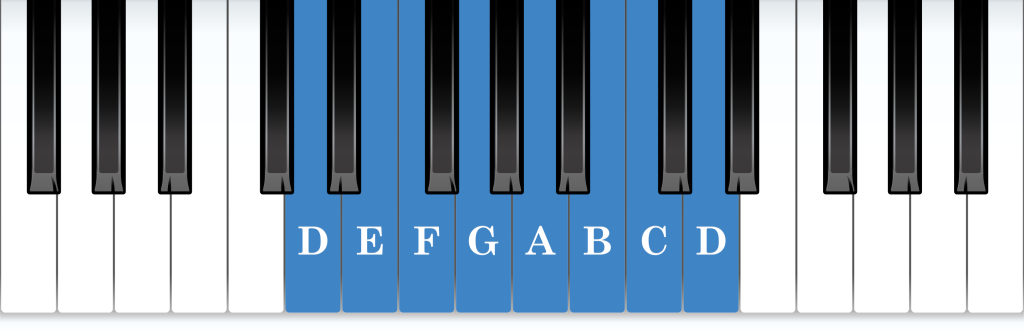
      D Dorian

      D Dorian mode piano notes diagram
      D E F G A B C D

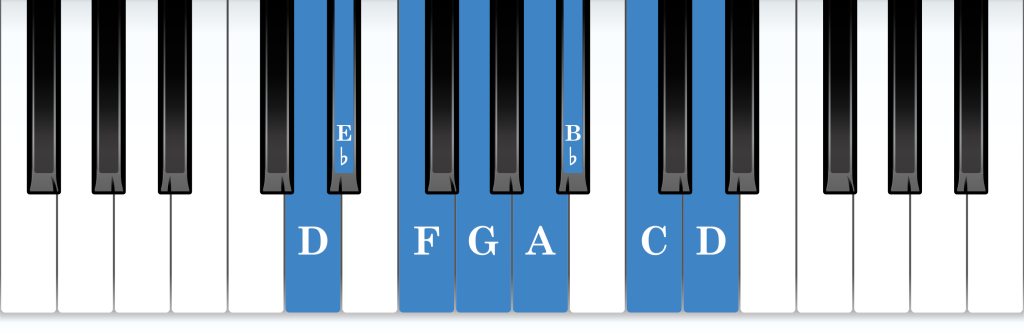
      D Phrygian

      D Phrygian mode piano notes diagram
      D E♭ F G A B♭ C D

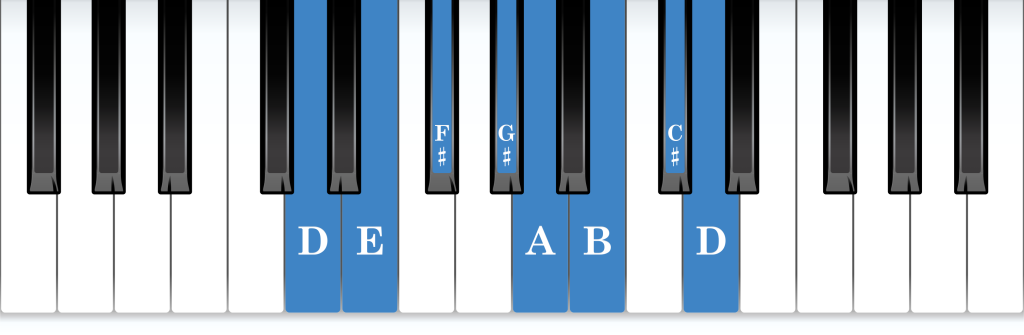
      D Lydian

      D Lydian mode piano notes diagram
      D E F♯ G♯ A B C♯ D

      D Mixolydian

      D Mixolydian mode piano notes diagram
      D E F♯ G A B C D

      D Locrian

      D Locrian mode piano notes diagram
      D E♭ F G A♭ B♭ C D

      Questions and answers

      No questions on this lesson yet. Be the first to ask one.

      Scroll to Top

      Ask a question about this lesson

      Questions go straight to Loren. Answers are posted at the bottom of the lesson.

      Your email is only used to reply and is never shown on the site.